

How the Trade Ports Development Act and Public-Private Partnerships are Shaping Greater Gallup’s Future
19 Oct 2026
News
As New Mexico positions itself at the forefront of global logistics, trade, and regional infrastructure, the Greater Gallup region stands at a historic turning point. Moving from years of strategic planning to real-world capital execution, the Gallup-McKinley TradePort initiative represents a catalyst for long-term economic diversification.
Central to this transition are two powerful financial and regulatory mechanisms highlighted at the 2026 Economic Roundtable hosted by the Greater Gallup Economic Development Corporation (GGEDC): the landmark Trade Ports Development Act (House Bill 19), including its provision authorizing the use of Public-Private Partnerships (P3s).
The Trade Ports Development Act
The passage in 2025 by the New Mexico Legislature of House Bill 19, the Trade Ports Development Act, marked a structural evolution in how the State funds and manages large-scale trade infrastructure. Backed by a $50 million special appropriation, the Act creates a formal legislative framework enabling qualified regional trade port districts, such as the Gallup-McKinley TradePort (designation pending), to access dedicated state funds, establish district boundaries, and accelerate infrastructure readiness.
Companion legislation, including the Strategic Economic Development Site Readiness Act (SB 169) and the Utility Pre-deployment Initiative (SB 270), reinforces HB 19 by providing direct resources to prepare shovel-ready industrial sites. Under this statutory framework, industrial hubs such as the Gallup Energy Logistics Park (GELP), recognized by Economic Development New Mexico as a top-five ready-for-development industrial park in the state, are fully positioned to capture national and international market demand.
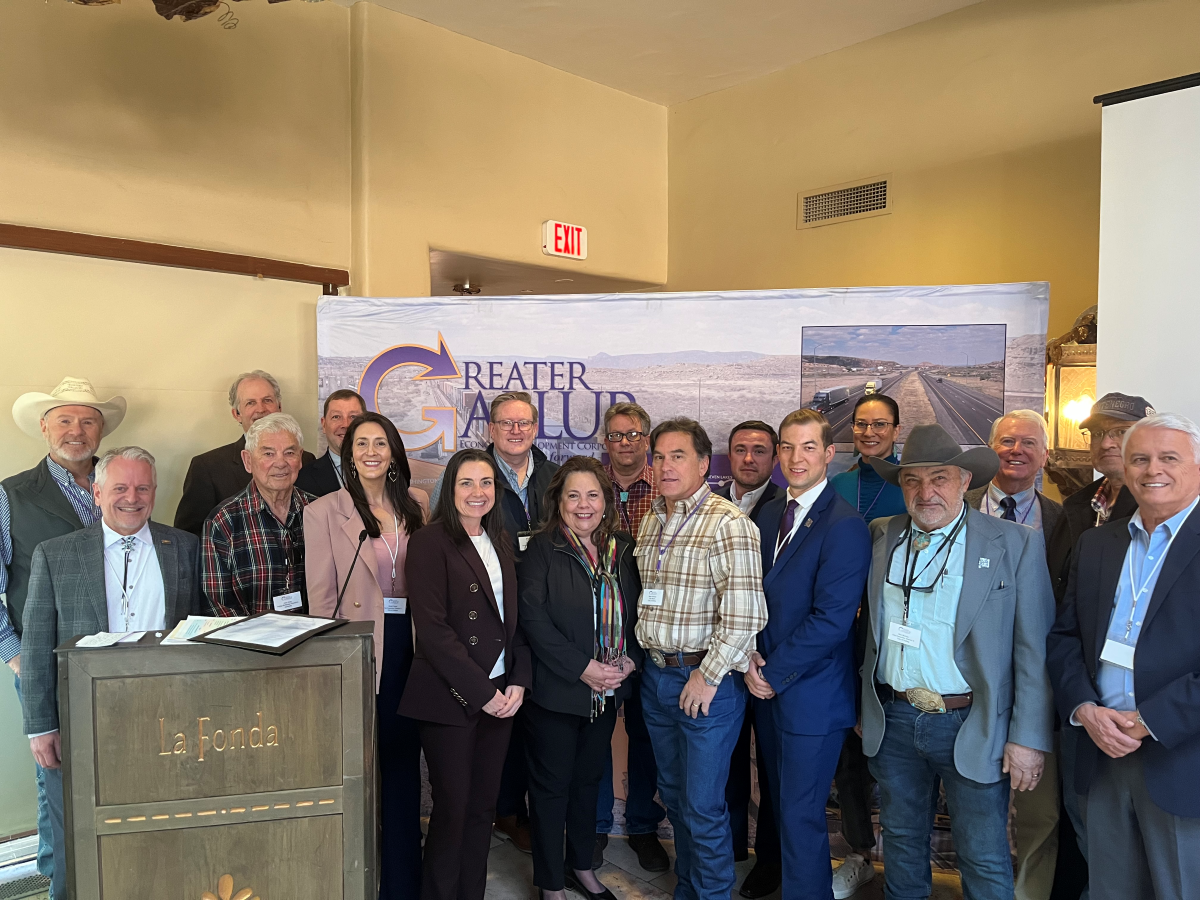
Economic Roundtable Participants: (Back row, from left to right): Rick Murphy, VP of the GGEDC Board of Directors, Tony Tanner, Member, GGEDC Board of Directors, Tim Gourley, Roundtable Keynote Speaker, PE with Gutami USA, Tommy Haws, President of the GGEDC Board of Directors, Frank Chiapetti, City Manager, City of Gallup, Maksim Yashirin, Regional Manager of Economic Development, BNSF Railway, Sierra Yazzie Asamoa-Tutu, District 2 City Councilor, City of Gallup, Jeff Kiely, Consultant to GGEDC and Roundtable facilitator, Robert Baca, President, McKinley County Board of Commissioners, (Front row, left to right): Bruce Armstrong, Economic Development Manager, GGEDC, John Peña, Board Member, Gallup McKinley TradePort Authority, Sarah Piano, District 3 Councilor, City of Gallup, Lindsay Mullins, Executive Director of Public Affairs, BNSF Railway, Patty Lundstrom, GGEDC Executive Director and NM District 9 State Representative, Marc DePauli, Mayor, City of Gallup, Isaac Romero, Deputy Cabinet Secretary, NM Economic Development Department, Ron Molina, District 4 Councilor, City of Gallup, and Clemente Sanchez, Senator, District 30, NM State Senate (retired)
Public-Private Partnerships: Bridging Capital and Capability
While statutory tools establish the legislative framework, delivering complex infrastructure requires capital and operational agility beyond traditional public budgets. This is where P3s become indispensable. Explicitly authorized under HB 19, expanded P3 authority allows public entities to establish formal legal or contractual joint relationships with private developers and investors.
Rather than relying solely on municipal debt or limited grant funding, structured P3s allow local governments to:
- Access private capital markets to fund major horizontal and vertical infrastructure, including utility extensions, energy microgrids, and industrial park logistics assets.
- Transfer complex construction, technological, and long-term operational risks to private partners best equipped to manage them efficiently.
- Align public planning with private-sector execution speed, meeting the tight 18-to-24-month site selection windows required by global industrial prospects.
In short, P3s leverage private equity and debt, optimize and share risk allocation, and accelerate delivery timelines.
Utilizing New Mexico’s Financial Toolbox
One of the core takeaways from GGEDC’s expert panelists is that successful TradePort execution requires a layered financial approach. P3 frameworks operate best when integrated with New Mexico’s complementary statutory mechanisms, such as:
- Local Economic Development Act (LEDA)
- Industrial Revenue Bonds (IRBs)
- Public Improvement & Tax Increment Development Districts (PIDs & TIDDs)
- New Mexico Finance Authority (NMFA) & Infrastructure-as-a-Service Models
From Planning to Capital Deployment
With strong local alignment between the City of Gallup, McKinley County, and regional economic partners, the groundwork is set. By combining legislative backing from the Trade Ports Development Act with transparent, well-structured P3 agreements, Greater Gallup is facilitating the creation of a bankable environment that protects public interest while attracting private investment.
The next phase is execution: transforming regional logistics potential into high-wage jobs, durable infrastructure, and resilient economic growth for generations to come.
The GGEDC will be conducting another roundtable this coming February. To follow along for future developments, or to learn more about the mechanisms discussed above, keep in touch with the GGEDC team.
More Topics


